Maximize Ontario HST Rebates for Garden Suites
HST Rebates, Ontario Garden Suites, Laneway Homes
Ontario Garden Suite HST Rebate and Laneway Home Rebates: What CRA Really Allows
Discover how Ontario homeowners can maximize HST rebates for garden suites and laneway homes. Learn CRA rules and claim strategies so you do not leave money on the table or risk a surprise reassessment.
Why HST Rules for Garden Suites and Laneway Homes Are So Confusing
If you have built, or are planning to build, a detached garden suite or laneway home on your Ontario property, you have probably heard that there are HST rebates available. You may also have heard horror stories about people having to pay HST back after an audit. Both can be true, depending on how you set things up and which rebate you claim.
The Canada Revenue Agency’s info sheet GI‑168 – GST/HST Implications of the Construction of Secondary Housing Units (Laneway Housing) explains how HST applies when you build a secondary unit such as a laneway house or detached garden suite (canada.ca). It is not light reading. But buried in that document are a few key ideas that can make a big difference to how much rebate you receive and how safe your claim is from CRA review.
This guide from RebateMax, Ontario HST housing rebate specialists, breaks those rules into plain language for homeowners. We focus on four big points that matter most for the Ontario garden suite HST rebate and laneway home rebate Ontario opportunities, based on CRA’s own guidance in GI‑168 and the current federal rebate rules.
💡 Plain-language promise: Whenever we use a tax term, we explain it right away. No accountant-speak needed.
1. Each Detached Garden Suite Is Its Own “Single-Unit Residential Complex”
One of the most helpful ideas in GI‑168 is that a detached garden suite or laneway home is usually treated as its ownsingle‑unit residential complex. In simple terms, CRA looks at each separate, self-contained home as its own property for rebate purposes, even if it shares a lot with your main house (GI‑168).
Why does this matter? Because both the federal new housing rebate and the new residential rental property rebate have a key limit: the $450,000 fair market value threshold. To qualify for the federal portion, the fair market value (what the unit would sell for on the open market) must be under $450,000 at the relevant time, usually when the home is substantially complete or first lived in (canada.ca).
The key point: for a detached secondary unit, CRA does not lump the value of your main house together with the garden suite. Instead, each detached unit is tested on its own. That means the $450,000 limit applies separately to each suite, not to the whole property as one big number. This is a big deal for anyone adding more than one unit to their lot.
📌 Key takeaway: For rebate purposes, CRA treats each detached garden suite as its own “mini property” with its own $450,000 fair‑market‑value test.
2. Two Different Rebate Paths: Family Use vs. Rental to a Non‑Relative
Once you know each detached unit is looked at on its own, the next question is simple: Who is going to live there? The answer drives which rebate path you can use. CRA gives you two very different routes, and picking the wrong one is one of the most common (and expensive) mistakes we see at RebateMax when homeowners try to DIY their garden suite tax rebate Ontario claims.
Path A: A Family Member Uses the Suite as a Primary Residence
If the garden suite or laneway home will be the primary place of residence for you or a close family member, you may be able to use the GST/HST new housing rebate under the owner‑built rules. This is the same basic program that applies when someone builds a custom home for themselves, but GI‑168 confirms that it can also apply to qualifying secondary units used as a primary home by the owner or a relation (GI‑168).
In plain language, this path is for situations like:
You build a detached garden suite for your aging parent to live in full‑time.
You construct a laneway home where your adult child will live while they attend school or start their career, and it is their main home.
To claim this rebate, you use the owner‑built new housing form GST191. In simple terms, this form lets you recover part of the HST you paid on construction costs (and, in some cases, on the land portion that is tied to the unit) as long as:
The suite is a self‑contained housing unit with its own kitchen, bathroom, and sleeping area.
It is used as the primary residence of you or a close family member (not a short‑term rental or student rooming house).
The fair market value of the unit (plus the land reasonably tied to it) is under $450,000 at completion (canada.ca).
💡 Pro tip from RebateMax: CRA will want to see that the family member actually lives there as their main home. Keep things like utility bills, driver’s licence address changes, and lease or occupancy agreements in case they ever ask.
Path B: You Rent the Suite to a Non‑Relative at Arm’s Length
If your plan is to rent the garden suite or laneway home to a non‑relative as a long‑term rental, you are in a different world. CRA treats you more like a builder who has constructed a rental property. In that case, the builder self‑supply rules apply, and the main rebate path is the New Residential Rental Property (NRRP) rebate (GI‑168; NRRP guide RC4231).
In simple terms, here is what happens under the self‑supply rules:
When the unit is ready for its first tenant, CRA pretends that you sold the property to yourself at its fair market value.
You must self‑assess HST on that value. That means you calculate the HST as if there was a sale and report it on your HST return or by filing the appropriate forms, even though no money actually changed hands.
Once that “deemed sale” has happened and you start renting the unit out on a long‑term basis, you can apply for the New Residential Rental Property rebate to recover part of the HST tied to that fair market value, as long as the value is under $450,000 for a single unit (canada.ca).
For this route you typically use Form GST524 for the federal portion and the related Ontario schedule for the provincial portion. Timing is strict: you normally must file within two years of the first tenant moving in. This is exactly the type of deadline RebateMax tracks for clients so they do not miss out on thousands of dollars by applying too late.
Choosing the right rebate path early can save Ontario owners thousands in HST.
3. Common Traps: Double‑Dipping, Land Allocation, and “Real” Primary Residence Use
GI‑168 is full of small technical points, but three traps show up over and over again in real life. If you remember nothing else from this guide, keep these three in mind before you file any Ontario garden suite HST rebate or laneway home rebate Ontario forms.
Trap 1: You Cannot Claim Both Rebate Types on the Same Suite
It can be tempting to think, “I will claim the new housing rebate now while my daughter lives there, and later, once I rent it out, I will also claim the rental rebate.” CRA shuts that idea down very clearly. You cannot claim both the new housing rebate and the new residential rental property rebate for the same residential unit (GI‑168).
CRA’s logic is simple: both programs aim to give you relief on the same HST cost. Once you have recovered that tax under one program, you do not get to recover it again under another. Trying to double‑dip is a fast way to invite a reassessment, interest, and possible penalties. At RebateMax, a big part of our audit‑proof approach is mapping each unit to the single correct rebate path from day one so there is no overlap or confusion down the road.
Trap 2: Only the Land “Reasonably Necessary” for Each Suite Counts
Another subtle rule from GI‑168 is that when you work out the fair market value of a detached secondary unit, you do not get to include the whole lot. CRA only includes the land that is reasonably necessary for the use and enjoyment of that unit as a home (canada.ca).
In practice, that means:
The footprint of the main house is excluded when valuing a detached garden suite.
Shared driveways, yards, and outdoor spaces may need to be allocated between the main house and the suite based on what is reasonable.
Over‑allocating land to the suite could push its fair market value over the $450,000 limit and kill your federal rebate, while under‑allocating could look unrealistic in an audit.
Getting this land split right is one of the most technical parts of a garden suite tax rebate Ontario file. RebateMax often works with appraisers and uses CRA‑consistent allocation methods so that if CRA ever asks, there is a clear, defensible story behind the numbers on your forms.
Trap 3: A Family Suite Must Be a Genuine Primary Residence
For family‑use units, CRA cares about actual use, not just what you write on a form. To qualify for the owner‑built new housing rebate, the garden suite or laneway home must be the real primary residence of you or your relative. That means the place where they normally live, sleep, receive mail, and keep their personal belongings, not a unit they only use occasionally or rent out on the side (GI‑168).
CRA can and does check this by asking for documents like:
Driver’s licence address changes.
Utility bills in the occupant’s name.
School or work records showing that address as “home.”
If CRA concludes that a “family” garden suite was really an investment rental from day one, they can deny the new housing rebate, charge interest, and expect you to pay the money back. RebateMax’s audit‑proof approach includes documenting occupancy from the start so that if CRA ever asks, your file tells a clear and honest story that lines up with their rules.
⚠️ Warning: “Paper” primary residences that are really rentals are one of the fastest ways to lose your rebate in a CRA review. Make sure the story on paper matches real life.
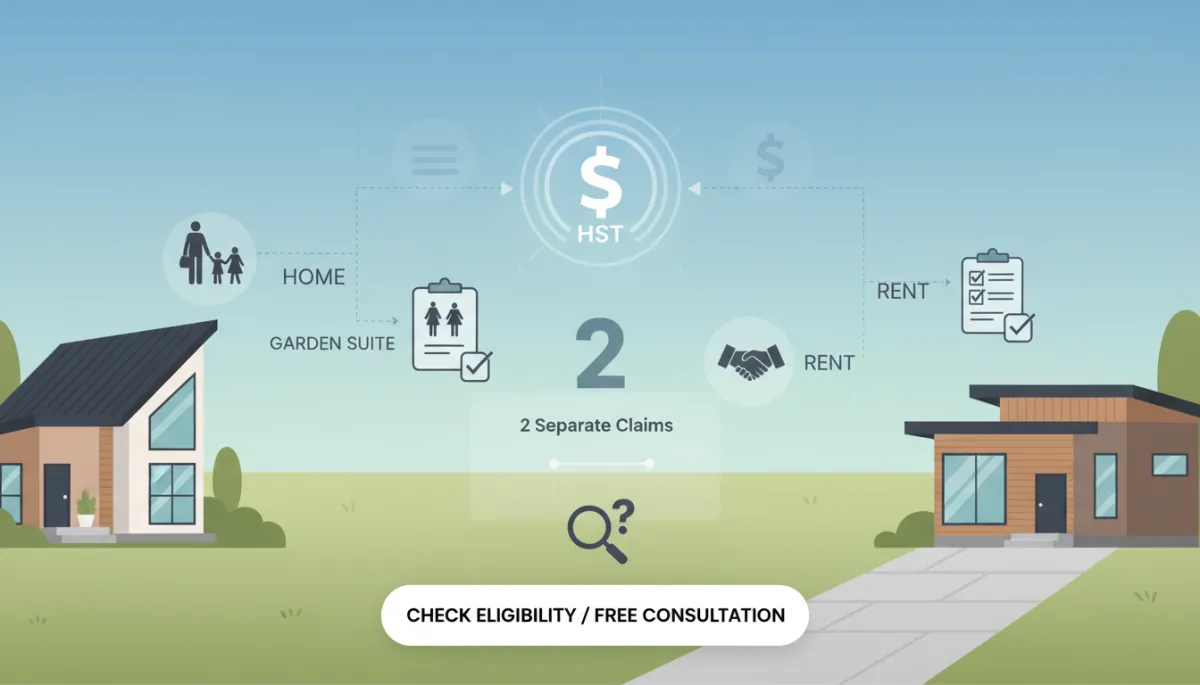
4. Two Garden Suites, Two Different Rebate Claims
Many Ontario homeowners are not stopping at one additional unit. With cities pushing for more “gentle density,” it is becoming common to see a main house plus two detached garden suites or a laneway home plus a backyard unit on the same lot. This can create a powerful rebate opportunity if you understand how CRA views each unit under GI‑168.
Remember: each detached suite is its own single‑unit residential complex, with its own fair market value and its own $450,000 test. That means a homeowner with two garden suites could be looking at two separate claims, each with its own rebate path, forms, and deadlines.
Example: One Family Suite, One Rental Suite on the Same Lot
Imagine this common scenario:
Suite A is a detached garden suite where your mother will live as her primary residence.
Suite B is another detached unit you will rent to an unrelated tenant on a one‑year lease.
In this case, CRA will normally treat Suite A and Suite B as two distinct single‑unit residential complexes. Assuming both have fair market values under $450,000 (each measured with only the land reasonably tied to that unit), you could be looking at:
A new housing rebate (owner‑built) claim on Suite A using Form GST191, because it is a genuine family primary residence.
A new residential rental property (NRRP) rebate claim on Suite B after you self‑assess HST on its fair market value and sign a long‑term lease with your arm’s‑length tenant.
These are two completely separate rebate files. They have different forms, different proof of occupancy, and often different timelines. But they are both driven by the same core ideas from GI‑168: each detached unit is its own complex, the main house footprint is excluded from the value for each, and you must pick the single correct rebate path for each unit rather than trying to stack programs on the same suite.
💡 How RebateMax helps: We build a separate, audit‑ready file for each unit on your property, mapping who lives there, how the land is allocated, which forms apply, and when each rebate deadline hits. You focus on your project; we handle the paperwork maze.
How RebateMax Makes Garden Suite and Laneway Home Rebates Stress‑Free
Building a garden suite, laneway home, or other accessory dwelling is already a huge project. You are juggling designs, permits, contractors, inspections, and financing. Layering CRA rules on top of that is the last thing most homeowners want to do. That is exactly why RebateMax exists.
We specialize only in Ontario HST housing rebates, including custom homes, substantial renovations, and secondary units like garden suites, ADUs, prefab and modular homes. Unlike general accountants, we live and breathe GI‑168, the NRRP guide RC4231, and the detailed rules around fair market value and occupancy timelines. Our job is to pull the maximum legal rebate out of your project while keeping your file clean and audit‑ready from day one.
Uncompromised financial protection: We refuse to file “creative” claims that might look good today but fall apart in a CRA audit tomorrow. Every number is backed by documents, valuations, and CRA‑consistent logic.
No‑win, no‑fee pricing: You pay nothing up front. Our fee comes only after your rebate cheque is secured, so there is zero financial risk to you during the process.
Radical transparency: We explain in plain language which rebates you qualify for, which you do not, and why. You will always know exactly what we are doing and what CRA expects to see.
Paperwork off your plate: We organize invoices, check contractor HST numbers, prepare forms like GST191 and GST524, and assemble a complete file so you are not stuck in spreadsheet hell after your build is done.
Next Steps: Check Your Eligibility Before the Clock Runs Out
CRA gives strict timelines for both new housing and new residential rental property rebates. In many cases, you have two years from the date the unit is first occupied to file your claim. If you miss that window, there is usually no way to reopen it, even if you were clearly eligible. That is why the best time to confirm your rebate strategy is before your garden suite or laneway home is finished—or as soon as possible if it already is.
Whether you are planning a project or already have tenants in place, RebateMax can review your plans, confirm which rebate path applies to each unit, and estimate how much you could recover. For many Ontario homeowners, the combination of federal and provincial rebates across a main build plus secondary units can add up to tens of thousands of dollars in HST relief—sometimes as high as $130,000 when major custom builds or substantial renovations are involved.
📌 Key takeaway: The sooner you map each unit (family vs rental, fair market value, land allocation), the easier it is to build an audit‑proof file and maximize your rebate.
Claim Your HST Rebate with Confidence
If you have built or are building a garden suite, laneway home, prefab ADU, or any other secondary unit in Ontario, you do not need to guess your way through GI‑168 and CRA forms. Let a team that lives in this world every day guide you through it, step by step, in plain language and with full transparency about what you qualify for.
Claim Your HST Rebate — Start Your 60‑Second Qualification Audit. Share a few details about your project, and RebateMax will quickly tell you which rebate paths are open, how much you may be owed, and what documents we need to build an audit‑proof file. There are zero upfront fees, and our service is 100% risk‑free—we only get paid when your rebate is secured.
Do not forfeit up to $130,000 in potential relief. Check your two‑year deadline, confirm your eligibility, and let RebateMax turn a confusing set of CRA rules into a clear, stress‑free rebate cheque in your hands.